Meet Tanis
Pragmatic, confident, and refreshingly no-nonsense, she’s always lived life on her own terms. That spirit of independence has been with Tanis since childhood.
“I was an only child, outdoorsy, not concerned with the box the world tried to put little girls into,” she says.
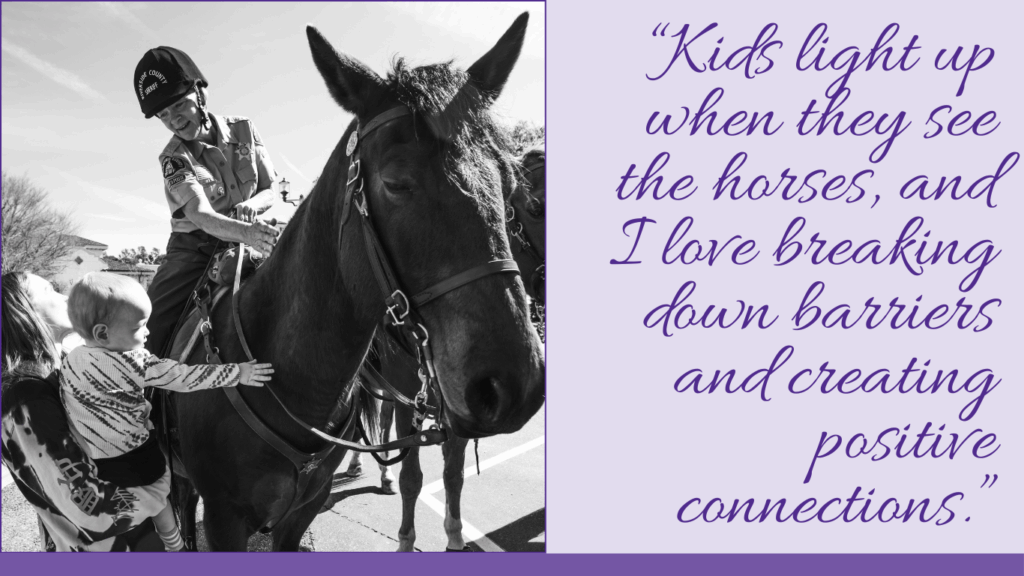
Early on, horses became her sanctuary. Her very first word was “Horsey,” her mom would laugh. That love only deepened over the years, leading her to the Temecula Valley Volunteer Mounted Posse, where she now serves as president. “We put a friendly face on policing,” she explains.
But beneath her confidence and no-nonsense edge, lies another story, one that shaped the way Tanis faced her own cancer diagnosis.
A Family History of Cancer
At a young age, Tanis watched her mother, a massage therapist and strong believer in holistic and Eastern medicine, battle breast cancer. Her mom chose a conservative path. First came a lumpectomy, and when the cancer returned, rounds of chemotherapy. Then more surgery. Then radiation.
“It seemed to drag on forever,” Tanis remembers. “She had a great deal of suffering, and I didn’t understand why she kept taking such a cautious approach.”
Her aunt’s journey was just as difficult. She endured chemotherapy, radiation, and a radical mastectomy on one side, only for the cancer to return in the other breast.
Seeing both women fight, and fight again, left a mark on Tanis. So, when her own diagnosis came, she knew exactly what she would do.
Facing Her Own Diagnosis
“I’ve always been diligent about taking care of myself and having an annual mammogram and this year it was not good.” She explains.
Diagnosis came in. Early-stage triple-negative breast cancer (TNBC), a rare and aggressive kind of breast cancer, was not a complete shock. “You know, I was just like, take them off. It’s your turn. I’m not in this for the long haul. I’m not gonna play with singing bowls and herbs. There’s a time and place for that, sure, but after watching my mom and my aunt, I said, ‘Nope. Let’s go. Let’s do this.’”
True to form, Tanis went all in, an aggressive, full-force approach. Because that’s who she is: decisive, pragmatic, and unwilling to let fear or hesitation dictate her path.
Discovering Michelle’s Place
Working for the City of Temecula, Tanis often saw Michelle’s Place at community events. “I’d seen the booth, seen the table, seen the faces,” she recalls. “But I had never actually been inside.”
That changed after her diagnosis. Co-worker and Michelle’s Place board member, Annie wouldn’t let up. “She kept saying, ‘You gotta go in.’ Finally, she put an appointment right on my calendar, and I showed up,” Tanis laughs. The visit made an immediate difference. “The volunteers welcomed me with open arms. I got a wig, a tour, and discovered resources I didn’t even know existed.”
“It felt like someone had already thought through what I would need before I asked, and I wished I had turned there for help sooner.”
The Challenges of Care
Outside those walls, the reality of navigating cancer care had hit hard. “The biggest frustration was trying to find a doctor,” Tanis admits. “You leave 20 voicemails, you search your insurance website, and every name that pops up is either not taking new patients or can’t see you for months.”
From the time of the mammogram to the start of treatment, almost four months dragged by. The waiting, the dead ends, the unanswered calls, it was exhausting. Until, one day, something shifted.
I called another office, bracing for the same answer, and the receptionist could probably hear in my voice how desperate I was,” Tanis recalls. “She took pity on me and said, ‘The doctor you are calling for does not have availability but there’s another doctor here that I can try to schedule you with.’
That simple act of compassion opened the door to new hope. Dr. Solomon, a Loma Linda surgeon who held monthly office hours in Murrieta, and Dr. Nagaraj, an oncologist, both part of Redlands Loma Linda University Health’s cancer research team. Together with their dedicated staff, they laid out the details of a new research study focused on her specific type of cancer. Tanis immediately felt it was the right opportunity and said yes.
A New Approach
The team fully explained a clinical trial that was testing a shorter, Anthracycline free chemo- immunotherapy. The goal was to see if giving fewer chemotherapy drugs over less time could be just as effective as the standard treatment, while reducing harmful side effects by limiting exposure to toxic medicine.
After watching her mother and aunt endure years of grueling treatment, the choice was a no-brainer. For Tanis, joining the trial wasn’t just about her own fight, it was also about using her experience to help improve treatments for those who would come after her.
The Hardest Part
Chemotherapy was brutal. There’s no other word for it. Still, Tanis pushed through, determined to live as normally as she could, even when her body begged for rest. Looking back now, she wishes she had given herself more grace. But at the time, there was no space for second-guessing.
To Reconstruct or Not to Reconstruct
Next came the talks of reconstruction. Everywhere she turned, Tanis heard the same lines:
“You’ll regret it if you don’t get reconstruction.” “It’s all paid for.”
But instead of feeling supported, she felt pressured, even pushed toward something she knew in her gut she didn’t want.
“I briefly entertained the idea,” she admits, even going to two plastic surgeon consultations, “but quickly came to the conclusion that perky new boobs were not for me.”
“Most people don’t realize how complicated the implant process really is. To me, it sounded almost worse than breast cancer itself, with all the extra surgeries and long recovery time, when all I really wanted was to be done and get back on my horse.” she says, shaking her head. I know there are women out there who feel the same, but in the overwhelm of it all, it’s easier to just say yes to what many doctors are pushing.
What she wanted was simple: a surgeon who respected her choice to embrace the “flat aesthetic.” But she wasn’t being heard. So, true to form, Tanis took matters into her own hands.
Through research, she discovered Not Putting on a Shirt, a movement of women advocating for flat closure after mastectomy.
“It was exactly what I needed. A reminder that it’s my body, and nobody can tell me to have implants if I don’t want them.”
She began searching for doctors who not only understood but supported this choice. That’s when she found Dr. Sharon Lum, identified on the group’s website as a surgeon with expertise in this particular surgical method. “She said, ‘I know exactly what you’re asking for, and I’ll be your surgeon, along with Dr. Solomon. We’ll do this as a team.’”
Back in the Saddle
Seventeen months after her diagnosis, and just two months after finishing all treatments, Tanis is back in the saddle and, she says happily, her boobs no longer bounce uncomfortably at the trot. Her cancer is now considered NED (No Evidence of Disease), and cancer research is one step closer to better treatments, thanks to her willingness to participate and the dedicated team of doctors who guided her treatment.
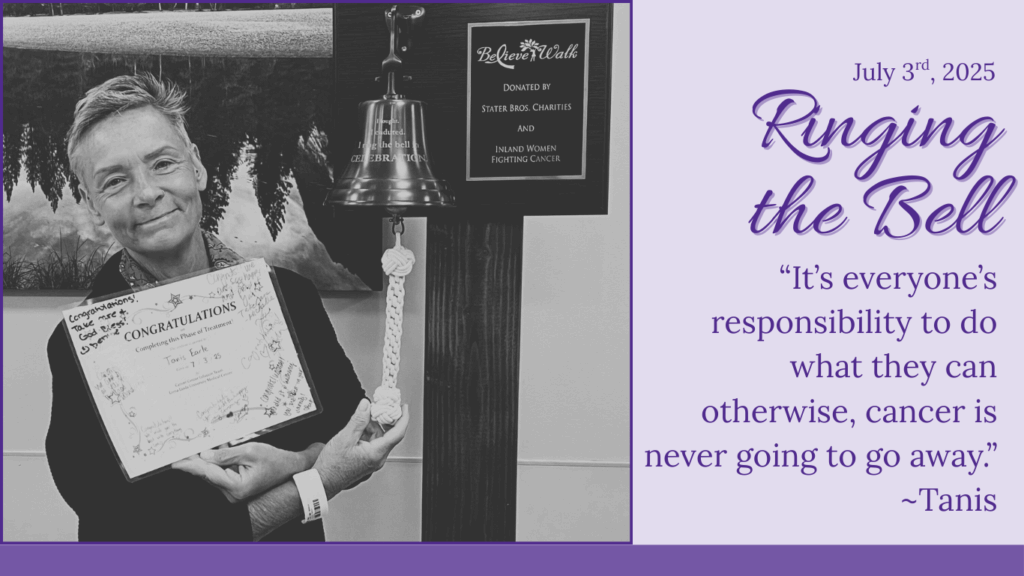
“I don’t know anyone who hasn’t been affected by cancer in some way, a loved one, a friend, or themselves. That’s why cancer research is so important,” Tanis shares. “It’s everyone’s responsibility to do what they can; otherwise, cancer is never going to go away.”